Housing and Workforce take Center Stage at REDI's News & Brews
Housingand Workforce Take Center Stage at REDI’s News & Brews
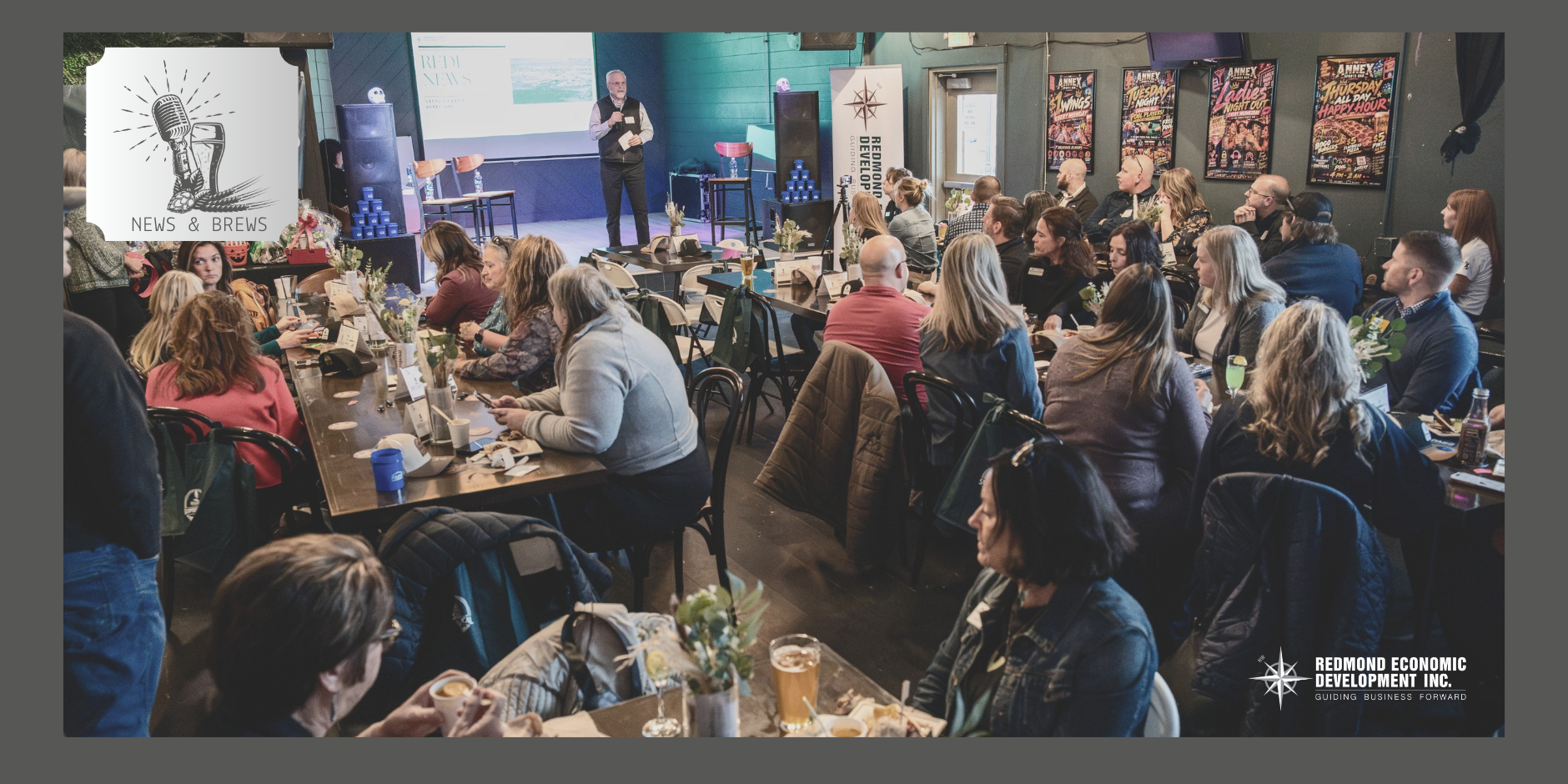
More than 100 attendees gathered at General Duffy’s Annex to explore Redmond’s housing market and its connection to business growth and employee retention.
Helping employees find a place to call home is an economic development issue. That connection brought more than 100 attendees to General Duffy’s Annex on October 28, 2026, for Redmond Economic Development Inc.’s News & Brews.
The event combined networking, a REDI project update from Director Steve Curley, and a housing panel examining local affordability, construction costs, and the homebuyer experience. A company spotlight on PARR offered a closer look at the local manufacturing and building services supporting residential construction across the region.
Kevin White, Executive VP Oregon with Deschutes Title Company, moderated the panel featuring Linda Cline, Housing Program Analyst with the City of Redmond; Jenn Kovitz, Senior Community Engagement Manager with Hayden Homes; and Amber Wilson, Senior Mortgage Advisor with Advantage Mortgage. Wilson also serves as the Chair for the City of Redmond Housing and Community Development Committee.
Housing costs and local purchasing power
Cline connected Redmond’s housing costs to the wages earned by people working in the community. Her presentation cited a median home price of $499,000 from the October 2026 Beacon Report and an average monthly rent of $1,744 for a two-bedroom apartment from Apartments.com.
Using household income and occupation examples, she illustrated the challenge of matching local earnings with housing costs, even for households with two wage earners.
Cline also explained that building permits provide only part of the housing production picture. A permit issued in one year may not result in a completed home until a later year. At the time of the event, she reported that Redmond had not yet issued multifamily building permits in 2026, although projects were pending.
Looking ahead, she outlined the City’s work to assess housing needs, buildable land, and strategies to support future production. She emphasized that cities have several tools available, including development codes, certain fees, and land-use planning, while many factors influencing construction remain outside their control.
Using the Northpoint project as an example, Cline described how a Planned Unit Development land use process permits greater flexibility in land use regulations in exchange for community benefits such as parks, childcare, and commercial space.
“I think there’s some hope with some creativity,” Cline told attendees, emphasizing the importance of collaboration between the City and developers.
The builder’s perspective
Kovitz connected attainable homeownership directly to the challenges employers face in recruiting and retaining workers.
Her presentation illustrated a $36,503 gap between the home price affordable at the area’s median family income and the home price benchmark used in Hayden Homes’ analysis. That example assumed U.S. H.U.D. data, a 7% interest rate, a 5% down payment, and 30% of income devoted to housing.
She also shared Hayden Homes’ average starting home price of $400,000 in Redmond at the time of the presentation, explaining the company’s focus on bringing homes to market within reach of the area median wage-earner.
Kovitz walked attendees through the costs behind a new home, including materials, labor, land, infrastructure, permitting, and financing. She identified land costs as a significant obstacle to affordability and encouraged the business community to participate in discussions about development processes and housing policy.
“My ask is that you support housing-focused policy as a tool for strong economic development,” Kovitz said.
Understanding the buyer’s experience
Wilson described an affordability challenge extending beyond credit scores and saving for a down payment. In her work, she is seeing buyers who have steady employment, strong credit, and money saved but still struggle to afford available homes.
She reported seeing more family assistance and people purchasing homes together. Buyers are also comparing lenders and asking more questions as they try to understand their options.
Wilson emphasized starting with a household’s comfortable monthly payment and working through the financing choices that may fit its circumstances. She discussed how seller contributions and interest rate buydowns can factor into those conversations, depending on the transaction.
Despite the challenges, she emphasized that interest in homeownership remains.
“They’re asking questions. They want to buy homes,” Wilson said.
Practical ideas for employers
The panel offered several ways businesses could help employees navigate housing.
Wilson suggested employers explore down payment assistance, potentially through matching contributions or benefits tied to length of service.
Kovitz proposed a more accessible starting point: employee lunch-and-learn sessions with trusted housing professionals. These sessions could help employees understand monthly payments, financing terminology, and the questions to ask when considering a purchase.
The discussion gave employers options to consider based on their budgets and staff needs, while reinforcing the connection between housing opportunities and a stable local workforce.
PARR connects local manufacturing to housing construction
The company spotlight featured Jeff Frost, PARR’s Division Sales Manager for Central, Southern, and Mid-Willamette Valley Oregon. Born and raised in Redmond, Frost described how the company’s local operations support builders and contribute to the regional construction industry.
Founded in 1930, PARR remains a fourth-generation, family-owned company. At the event, Frost shared that its network had grown to 47 locations across Oregon and Washington, while retaining longstanding connections to Redmond through businesses including the former Copeland Lumber, Quality Truss, and Suburban Door.
Today, PARR’s reach goes well beyond lumber. Its products include engineered wood, trusses, Opti-Frame wall components, windows, doors and millwork, cabinets, decking, and siding, serving production and custom builders, remodelers, and commercial contractors.
Frost emphasized PARR’s connection to Redmond as a community where the company employs people and operates businesses supporting the regional building industry. Its Redmond operations include roof and floor truss design and manufacturing, along with door and millwork production. Together with PARR’s lumber, design, and building supply resources in Bend and Prineville, these operations help builders move projects from planning through completion.
“The goal is simple. Help builders protect cycle time andkeep projects moving,” Frost said.
One example is PARR’s Opti-Frame system, which supplies precut, labeled framing components to job sites. Frost described how the system can shorten framing time, reduce material waste, and limit the cutting required onsite. The approach connected directly to the housing panel’s discussion of affordability by illustrating how suppliers can help builders manage construction time and materials.
During audience questions, Frost also shared his observations about remodeling and accessory dwelling units, or ADUs. He reported seeing homeowners invest in additions, replacement windows, doors, and other improvements as they choose to remain in their existing homes longer. Remodeling and large custom projects, he said, had remained steadier parts of PARR’s business in a challenging housing market.
Frost’s presentation reinforced the evening’s broader message: Redmond’s housing needs connect to local employers, manufacturing capabilities, construction services, and community partnerships.
Community connections and a creative preview
Attendees also had an opportunity to contribute to artist Mark Jamnik’s Subliminal Story Art experience, previewing the creative process associated with REDI’s Thrive Award. The award will be presented at the REDI Investor Social on January 13, 2027.
REDI thanks Title Sponsor Deschutes Title Company; Presenting Sponsors Express Employment Professionals, Specialized Recruiting Group, and Summit Bank; Supporting Sponsors SunWest Builders and I3DManufacturing; and Venue Sponsor General Duffy’s. Raffle donors BASX, Polar Bear Gas & Wash, and Jonny’s Joint added to the evening’s activities.
News & Brews brought local data and industry experience into a shared conversation about helping Redmond’s businesses, employees, and community thrive.
Related News
REDI Celebrates Opening of Amazon’s New Facility in Redmond, Strengthening Central Oregon’s Logistics Infrastructure

From Blight to Beat: How General Duffy’s Helped Transform Downtown Redmond into Central Oregon’s Cultural Hub